
Holding a wake or vigil
We are carried. in bellies. in arms. in love. in hope.
in caskets. in urns. in grief. in memories.
our whole live into the next we are carried.
sara rian
I am here to offer you advice, as well as practical and emotional support if you wish to hold a home wake or vigil goodbye. In Berlin and the surrounding area. Find out more about my approach as a death doula and work with end of life and grief.
Prerequisites for a home wake or vigil
In Berlin, people who have died at home may remain in their own home for up to 36 hours after death. Alternatively, if they have died in a care home or hospice, they may be brought back home for this period. After this time, the deceased must be transferred to to special cooled facility.
In Berlin, a 36-hour period applies; in other federal states, periods ranging from 24 to 48 hours apply. A prerequisite is that there are no exclusion criteria, such as a notifiable disease. This means that the deceased may remain in their own home during this period. During this time, it is possible to say goodbye in peace and without pressure. Only once this period has expired must the deceased be collected and transported by the funeral director.
What happens during a wake or vigil?
There are no set rules for what happens during a home wake. However, it provides a unique and private space and can be whatever is comfortable and meaningful for those involved.
This may involve keeping the deceased at home for a few extra hoursIt may involve keeping the deceased at home for several more hours so that you can sit by their side. During this time, people can sit with them, hold their hand, talk to them, or simply be in their presence. The deceased may be cared for, washed and dressed together. Ceremonies may take place or a text may be read aloud. Memorial gifts can be collected or prepared. There can be moments of silence and quiet reflection, as well as prayer, the sharing of stories, tears and laughter, food, music and even dancing. A wake or home vigil can take place in a small circle or as a space where more people can say their goodbyes.
Children can also be present if they wish. They, too, need the opportunity to say goodbye to people who are important to them. It is important that a trusted adult explains to them in advance, in a way suitable for children, what to expect.
Time
Spending time at the deathbed used to be a normal part of life and the process of saying goodbye. A time to keep vigil over someone who has already passed away. A time to gather, to remember, and to accompany and honour the transition.
Nowadays, traditional wakes and home viewings are something of an exception in our culture and society. Even though it often seems otherwise, normally, bereaved family members do not have to act immediately or sort things out following a death. Most of the organisational steps and formalities can wait a while. We are allowed to take our time.


Honoring the transition
When someone has died, it often takes time to realise what has happened. Time to understand what has taken place and to come to terms with the present. Time to feel the sense of loss and, perhaps, the bond that remains. Not just once, but time and again.
Spending time at the deathbed, either alone or with others, allows one to take a deep breath and consciously acknowledge the moment of transition. In this way, one can do whatever one needs – either alone or with others – to say goodbye to the deceased and, in particular, to their body.
One’s own home offers a safe space for the bereaved and the deceased. For the grieving process that follows, it can be important, during this initial period, to have the opportunity to visit the deceased time and again, at one’s own pace
Preparing for the Final Journey: Care of the body
Care of the body after death involves the mindful washing and dressing of the deceased. Although these acts are of a practical nature, caring for a dead body is, at its core, a rite of passage. It offers the living a chance to say goodbye: final moments of contact with the deceased’s body. Final acts of love, such as anointing the body with fragrant oil or dressing them in their favourite clothes. Recognising the transition from the living to the deceased. Preparing the body of a deceased person for their final journey helps us to recognise what remains and to develop a bond that transcends death. All of this forms part of the grieving process and can help us to take the next steps.
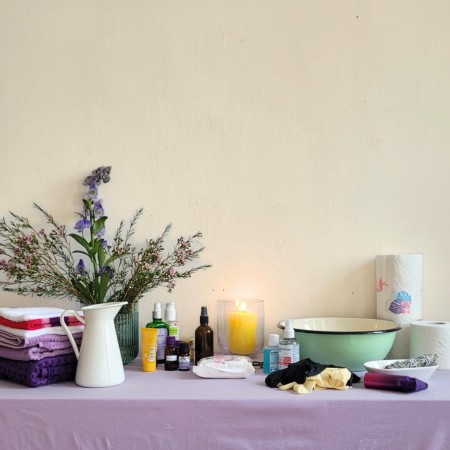

Washing & Dressing – Can I do this??
The way in which we care for the bodies of our deceased depends on many factors: cultural and religious background, the place and manner of death, the time of year, the condition of the body, and access to cooling facilities. It also depends on one’s relationship with the deceased and the other people involved, as well as one’s own current emotional state.
The idea of caring for a deceased person’s body oneself is initially uncomfortable for many people. Encountering death can be unsettling. However, people who choose to do so often find that it is not as unbearable, mysterious or complicated as is often assumed. And quite often, it feels good to have taken this step.
There is no right or wrong way to care for a deceased loved one. The aim of caring for the deceased is to tend to the body in such a way that the result reflects the individual wishes and personality of the deceased, whilst also meeting the needs of those who are grieving.
When it is not possible to hold a home wake or home vigil
Sometimes, due to various circumstances, it is not possible or desirable to say goodbye to the deceased at home. In such cases, it is usually possible to use the funeral home’s viewing rooms for this purpose. Many funeral homes also allow families and friends to be present or to be involved in after-death care.